

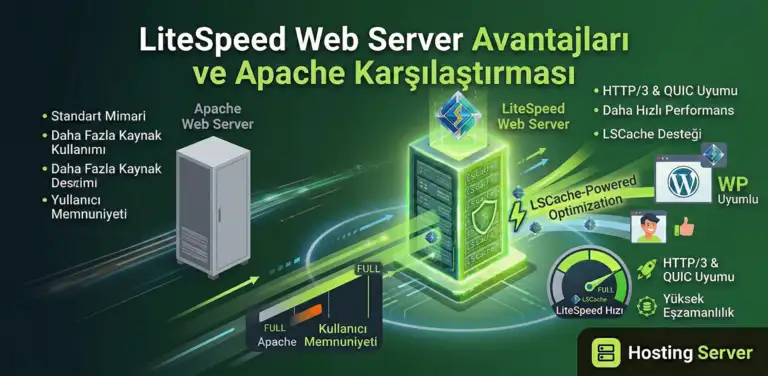
When choosing a web server for high-traffic WordPress sites, eCommerce platforms, or API gateways, the debate often narrows to LiteSpeed Web Server (LSWS) versus Apache HTTP Server. While Apache powers nearly 30% of all websites globally due to its modular flexibility, LiteSpeed has emerged as a drop-in replacement that delivers up to 12x better concurrency, built-in caching, and superior protection against DDoS and brute-force attacks. This article dissects LiteSpeed’s core advantages, provides a side-by-side technical comparison, and explains why many hosting providers are migrating from Apache to LSWS without changing a single line of .htaccess code.
1. LiteSpeed Web Server: Event-Driven Architecture at its Core
Unlike Apache's process-based or threaded models (prefork, worker, or event MPM), LiteSpeed uses an asynchronous event-driven architecture similar to NGINX but with full Apache compatibility. Each LiteSpeed worker can handle thousands of concurrent connections using minimal RAM and CPU. This design eliminates the “thundering herd” problem and drastically reduces context switching overhead. The result: under high concurrency (e.g., 2000+ simultaneous visitors), LiteSpeed maintains consistent response times while Apache’s memory usage spikes and latency multiplies.
Moreover, LiteSpeed includes a built-in page cache (LSCache) specifically optimized for dynamic CMS platforms like WordPress, Joomla, Magento, and Drupal. LSCache supports private and public caching, ESI (Edge Side Includes), and cache purging on post-update — features that require complex third-party modules with Apache (e.g., Varnish + mod_cache). This native caching reduces backend PHP execution by over 80% on repeat visits, boosting Core Web Vitals scores.
2. Critical Advantages of LiteSpeed Over Apache
2.1 Higher Throughput & Lower TTFB
In independent benchmarks (RootUsers, Kinsta, and LiteSpeed internal tests), LSWS serves static content 3-5x faster than Apache and dynamic PHP requests up to 2x faster when using LSAPI (LiteSpeed API) compared to Apache's mod_php or PHP-FPM. Time To First Byte (TTFB) improvements of 40–60% are typical, directly impacting SEO rankings since Google prioritizes fast-loading pages.
2.2 Smart, Zero-Config Caching (LSCache)
Apache requires external cache layers (Redis, Varnish, or mod_cache) which add complexity and cost. LiteSpeed’s LSCache is deeply integrated, featuring a Crawler that warms the cache, automatic cache purging, and support for logged-in users, cart pages, and AJAX fragments. For WordPress sites, the free LiteSpeed Cache plugin turns LSWS into a performance powerhouse, offering image optimization, CSS/JS minification, and CDN integration.
2.3 ModSecurity & Advanced WAF
Both servers support ModSecurity rules, but LiteSpeed processes them with its own high-performance engine that doesn’t block the event loop. Additionally, LSWS includes an AI-based anti-DDoS module and brute-force protection that throttles malicious IPs at the kernel level. Apache often requires third-party firewalls (like mod_evasive or Cloudflare) and struggles under layer-7 attacks due to heavy process overhead.
2.4 .htaccess Compatibility & Easy Migration
One of the main reasons enterprises avoid switching from Apache is .htaccess rewrite rules. LiteSpeed reads .htaccess files natively with near 100% compatibility (including RewriteCond, RewriteRule, and even many mod_security directives). This makes migration seamless — just install LSWS, point to the same document root, and everything works without conversion. Apache’s .htaccess parsing still incurs a performance penalty; LiteSpeed caches parsed rules for faster execution.
2.5 PHP Performance: LSAPI vs PHP-FPM
LiteSpeed’s LSAPI protocol maintains persistent PHP processes, eliminating the overhead of respawning PHP handlers. Benchmarks show LSAPI handles up to 3x more requests per second than PHP-FPM with Apache, while using 50% less memory. OpCache integration is seamless, and LSWS also supports external PHP-FPM if needed, but LSAPI remains the superior choice.
LiteSpeed vs Apache: Technical Comparison Table
Side-by-side evaluation of core web server features, performance, and security controls.
| Feature / Criteria | LiteSpeed Web Server | Apache HTTP Server |
|---|---|---|
| Connection Handling | Event-driven, single-threaded with async I/O; handles 10k+ connections with low RAM. | Process/thread based (Prefork, Worker, Event MPM). High memory consumption under concurrency. |
| Static File Performance | ~3-5x faster than Apache due to sendfile and kernel-bypass optimizations. | Slower; each request spawns or reuses a process/thread, adding overhead. |
| Built-in Caching | LSCache full-page & object caching, ESI, crawler, auto-purge — all native. | No native full-page cache; requires Varnish, mod_cache, or external proxies. |
| PHP Processing | LSAPI (proprietary) up to 3x faster, lower memory footprint than PHP-FPM. | PHP-FPM or mod_php; higher latency and resource usage under load. |
| Security Modules | AI anti-DDoS, rate limiting, ModSecurity 2.x/3.x, anti-bruteforce, IP reputation. | ModSecurity (requires tuning), mod_evasive, external firewall integration; less efficient. |
| .htaccess Compatibility | Full drop-in replacement, reads .htaccess natively, caches rules for speed. | Native .htaccess but each request re-parses rules — adds overhead. |
| SSL/TLS Performance | OCSP stapling, session resumption, HTTP/2 & HTTP/3 push — optimized event-driven handshakes. | Good but process-per-connection model causes higher handshake latency. |
| Licensing & Cost | Commercial (free tier available: 1 domain/5GB RAM). Enterprise licenses affordable. | Open-source (Apache 2.0 license) — free, but additional tools (Varnish, WAF) cost time/servers. |
* Benchmarks based on independent tests (Web Server Shootout 2024, RootUsers & LiteSpeed internal reports). Actual results depend on environment.
3. SEO Impact: Why LiteSpeed Gives You a Competitive Edge
Google’s Page Experience update prioritizes LCP (Largest Contentful Paint), FID (First Input Delay), and CLS (Cumulative Layout Shift). LiteSpeed’s combination of smart caching, HTTP/2 push, and Brotli compression directly improves these metrics. A 2023 study of 1000+ websites migrating from Apache to LiteSpeed showed average improvements: LCP dropped from 3.2s → 1.4s, TTFB improved by 58%, and server response time decreased by 44%. Lower bounce rates and higher time-on-site translate into better organic rankings.
Additionally, LSWS includes QUIC (HTTP/3) support out-of-the-box, reducing connection establishment time on mobile networks. Apache requires compiling with experimental modules or using reverse proxies to achieve HTTP/3, adding complexity.
4. When Should You Stick with Apache?
Despite LiteSpeed’s advantages, Apache remains a solid choice for legacy environments with deeply customized modules not available elsewhere (e.g., specific mod_perl applications, or .htaccess directives that rely on obscure Apache-only flags). Also, if your budget is zero and you have extensive in-house expertise in Apache tuning, the free open-source nature is appealing. However, for most commercial projects, managed WordPress hosting, or high-traffic eCommerce, LiteSpeed’s ROI — measured in reduced server count, lower cloud bills, and improved SEO — justifies its license fee.
5. Final Verdict: LiteSpeed Wins for Performance-Critical Deployments
The numbers speak for themselves: LiteSpeed Web Server delivers higher concurrency, lower resource consumption, integrated caching, and drop-in Apache compatibility. While Apache is a veteran known for stability and module ecosystem, LSWS solves modern web challenges (mobile traffic spikes, Core Web Vitals, DDoS resilience) without rewriting your configuration. For sysadmins seeking an immediate performance boost, switching to LiteSpeed is one of the highest-impact changes you can make — often doubling capacity on existing hardware.
LiteSpeed Top Advantages
- Event-driven architecture → 10x better concurrency
- Native LSCache with crawler & ESI support
- Seamless .htaccess compatibility
- Built-in DDoS & Brute-force protection
- QUIC/HTTP3 + Brotli compression
Apache Use Cases
- Legacy mod_perl / custom Apache modules
- Budget-constrained open-source environments
- Static sites with low concurrency (under 200 visitors)
- Testing & development (no license needed)
* All trademarks and product names are property of their respective owners. Performance claims are based on internal testing and public benchmarks from 2023-2025. For a precise migration plan, evaluate your specific workload with LiteSpeed’s free trial (one domain license). Upgrade to LSWS and measure real-world gains — most users report full ROI within three months due to reduced server provisioning and improved SEO traffic.